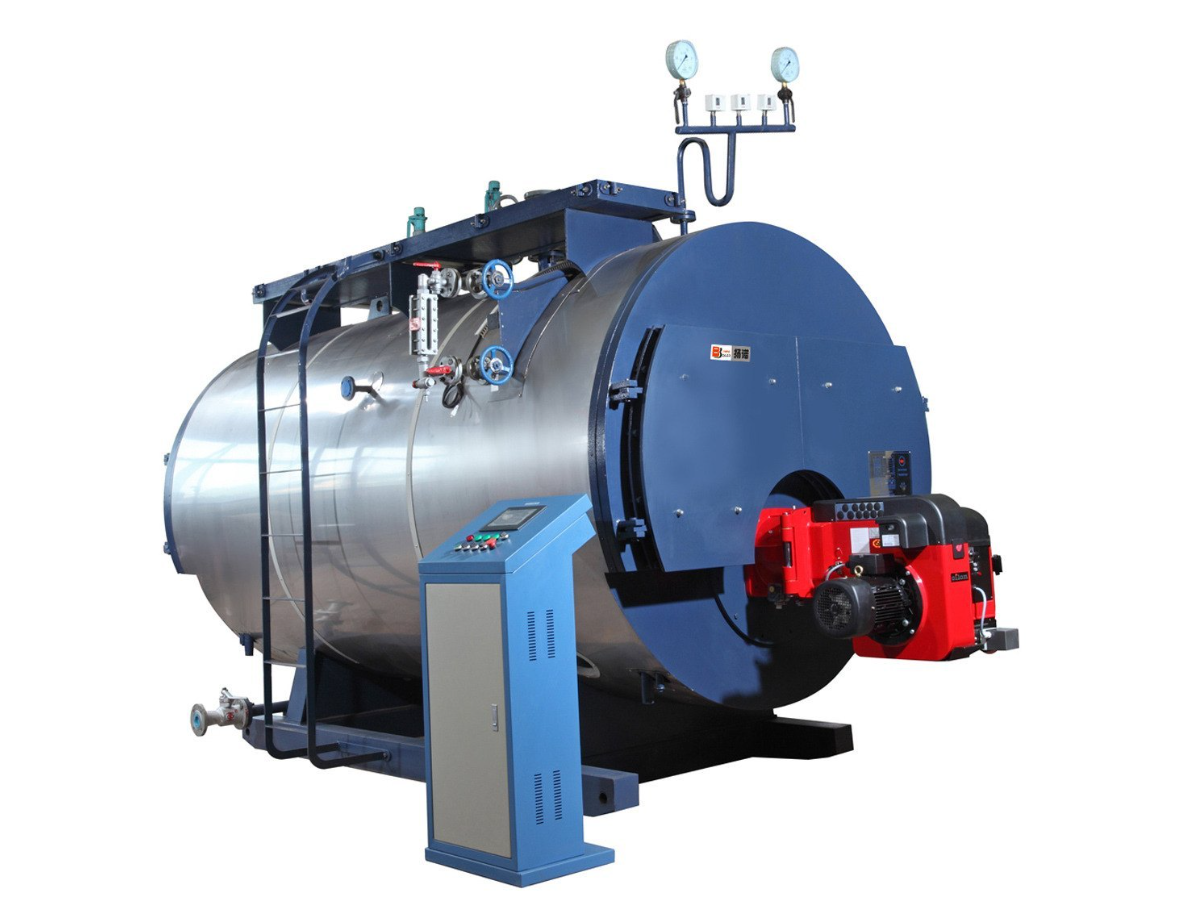
Horizontal Gas Or Oil Fired Thermal Oil Boiler
Key Info
| Rated Thermal Power | : | 120 kW to 14,000 kW+ (approx. 0.1 to 12 million kcal/h) |
| Max Operating Temp | : | Standard: 320°C; Custom: up to 400°C |
| Working Pressure | : | Low pressure, typically 0.8 – 1.1 MPa |
| Thermal Efficiency | : | 92% – 95% (can reach 97% with an economizer/air preheater) |
| Fuel Compatibility | : | Natural Gas, LPG, Diesel, Heavy Oil, or Dual-Fuel |
1. External Build & Layout
- Horizontal Cylindrical Design: The main body (the blue "drum") houses the combustion chamber and the concentric heating coils. The horizontal orientation is preferred for larger capacities as it provides a more stable center of gravity and easier access to the internal coils.
- Front Hinge Door: The large circular door at the front allows for easy opening to inspect the refractory lining and the burner interface.
- Skid-Mounted Frame: The entire unit sits on a heavy-duty steel I-beam frame, which allows for "plug-and-play" installation once it reaches the factory floor.
2. Primary Components (Visible)
- Burner (Front Center): The silver/grey unit mounted on the front door is the high-performance burner (likely a Riello or similar brand). This is where the gas or oil is mixed with air and ignited to create the flame that travels through the inner coil.
- Control Panel (Right Side): The tall, blue electrical cabinet contains the PLC (Programmable Logic Controller). This manages the automated start-up sequence, temperature modulation, and safety interlocks (like low-flow or high-temperature alarms).
- Inlet/Outlet Flanges: The yellow-capped pipes on top are the connections for the thermal oil. One is the Return (cooler oil coming back from the factory) and the other is the Supply (hot oil heading out to the process).
3. Internal Thermodynamics
The "Three-Pass" system works like this:
- First Pass: The burner fires into the center of the inner coil (the furnace).
- Second Pass: The flue gases reach the back, turn around, and flow forward between the inner and middle coils.
- Third Pass: The gases turn again at the front door and flow toward the back between the middle and outer coils before exiting through the chimney.
This path ensures that almost every bit of heat from the flame is absorbed by the oil before the exhaust leaves the system.
4. Technical Advantages
- Low Pressure, High Heat: It can heat the transfer oil up to 320°C (608°F) while remaining at a very low operating pressure (usually under 1.0 MPa). A steam boiler would need massive pressure to reach those temperatures.
- Precise Control: Because oil holds heat better than water/steam, the system can maintain a very steady temperature with a variance of only $\pm 1$°C.
- Durability: The coils are typically made of high-quality seamless carbon steel tubes, designed to withstand the thermal expansion and contraction cycles without cracking.